— and what actually happens in Gottman Method couples therapy?
The Gottman Method is one of the most researched approaches to couples therapy in the world. Here's what it involves, what the Sound Relationship House model means, and what to expect if you decide to try it.
When couples come to therapy, one of the most common things I hear is: "We don't know how to fight without it turning into a disaster." Or: "We've drifted apart and we don't know how to get back." Or: "We love each other, but something in how we communicate just isn't working."
The Gottman Method was developed specifically for these moments. Built on over four decades of research by Drs. John and Julie Gottman, it's one of the most empirically grounded approaches to couples therapy available — and it gives both the therapist and the couple a shared language for what's happening in their relationship and what can be done about it.
I'm trained in Gottman Method Couples Therapy and I integrate it into my work with couples and multi-partner relationships across all the specialty areas I work in — from navigating desire discrepancy to non-monogamy to relationship transitions. Here's what it actually involves.
The research behind it
The Gottman Method grew out of decades of observational research, much of it conducted at what became known as the "Love Lab" at the University of Washington. By observing couples in structured interactions and then following them longitudinally over years, the Gottmans and their colleagues were able to identify with remarkable accuracy which patterns predicted relationship stability and which predicted dissolution.
Among their most well-known findings: four communication patterns — criticism, contempt, defensiveness, and stonewalling — are so reliably associated with relationship breakdown that John Gottman called them "The Four Horsemen." Contempt in particular, which involves treating a partner as inferior or beneath consideration, is the single strongest predictor of relationship dissolution found in the research. These aren't just theoretical constructs — they're behaviors that can be identified, named, and changed.
The Sound Relationship House
The core organizing model of the Gottman Method is called the Sound Relationship House — a framework that maps the elements of a healthy, stable relationship across seven interconnected levels, held together by two load-bearing walls.
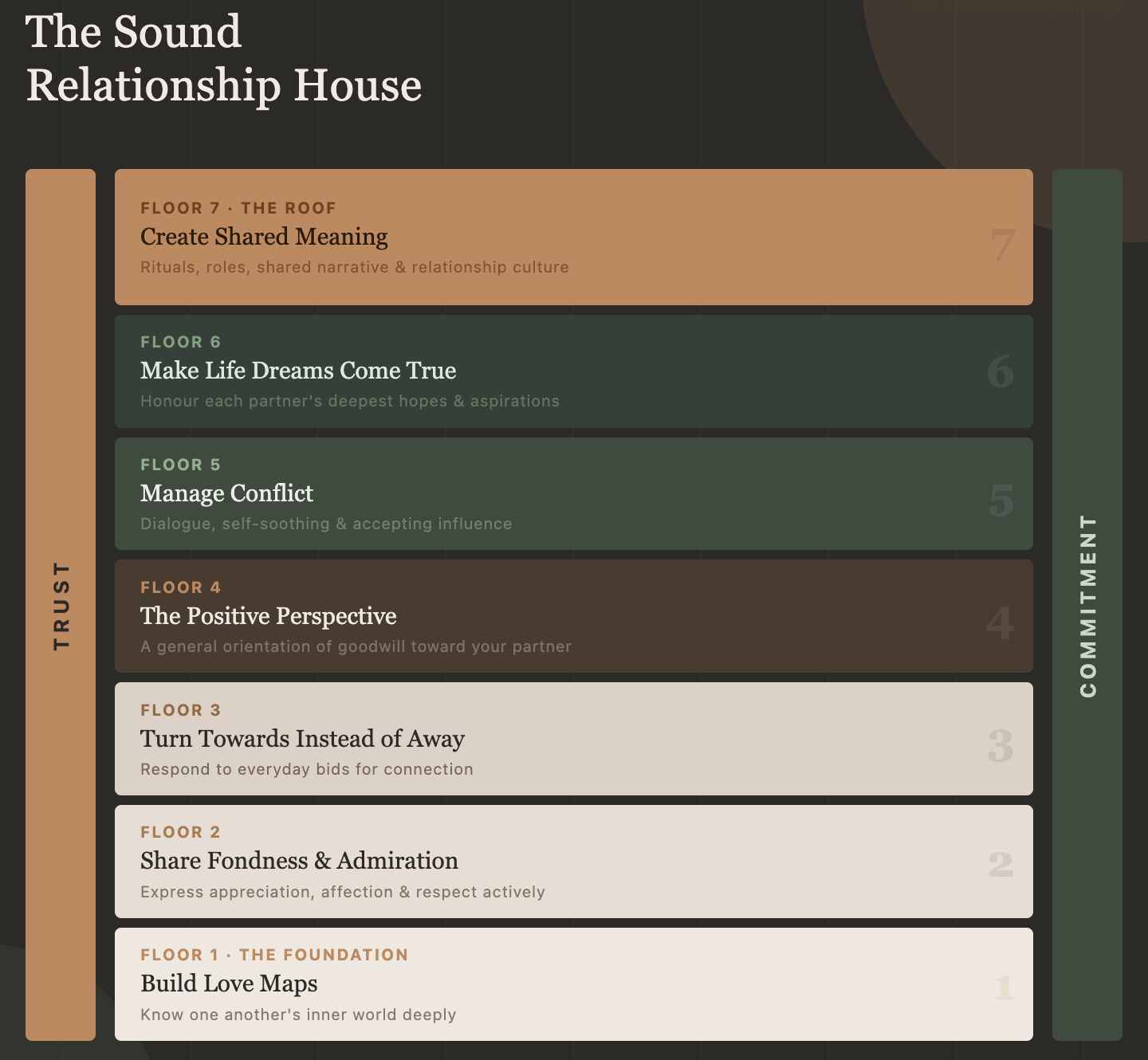
The foundation of the house is Build Love Maps — the practice of knowing your partner deeply: their world, their worries, their history, their dreams, the small details of their daily life. Love Maps erode over time when couples stop asking each other questions and start assuming they already know the answers.
The second level is Share Fondness and Admiration — actively expressing appreciation, respect, and affection. Gottman's research found that the ratio of positive to negative interactions in a relationship matters enormously: stable couples maintain roughly a five-to-one ratio of positive to negative interactions during conflict.
Turn Towards Instead of Away is the third level, addressing what Gottman calls "bids for connection" — the small, everyday moments when a partner reaches out for attention, affirmation, or engagement. Turning toward those bids (rather than away or against them) is one of the most reliable predictors of relationship satisfaction.
The fourth level is The Positive Perspective — a general orientation of goodwill toward your partner that makes it easier to give the benefit of the doubt, repair after conflict, and resist the pull toward negative interpretation of your partner's behavior.
Manage Conflict is the fifth level, and it's where the Four Horsemen framework lives most directly. The Gottman Method doesn't aim to eliminate conflict — conflict is normal and often productive — but to help couples navigate disagreement without the patterns that escalate it into damage. This includes distinguishing between solvable problems and perpetual problems (issues rooted in fundamental differences in personality or values), and learning to approach perpetual problems with dialogue rather than gridlock.
The sixth level is Make Life Dreams Come True — creating a relationship culture where both partners feel safe to express their deepest hopes, goals, and aspirations, and where those are honored rather than dismissed.
The seventh level, the roof of the house, is Create Shared Meaning — building rituals, roles, symbols, and a shared narrative that give the relationship its own culture and identity.
The two load-bearing walls that hold the whole structure together are Trust — the belief that your partner has your best interests at heart — and Commitment — the decision to invest in this relationship as your life together, rather than constantly evaluating alternatives.
What to expect in the first three sessions
One thing that distinguishes Gottman Method from some other approaches is that it begins with a structured assessment phase rather than jumping straight into the presenting problem. Here's what those early sessions typically look like in my practice:
Session one is a joint session. This is where we meet as a group — all partners together — and I hear about what's bringing you in, what you've already tried, and what you're hoping for. I also explain the framework I use and what the assessment process will involve. This session is as much about me getting a sense of the relationship's history and current state as it is about you getting a feel for how I work. There's no pressure to have everything figured out before you arrive — many people come in unsure exactly what they're trying to fix, and that's completely fine. There is also an opportunity to do a demo of your discussion style focused on a challenging topic while I am a fly on the wall, just observing without intervening.
Session two involves individual sessions with each partner separately. This is one of the more distinctive features of Gottman Method work — meeting individually gives each person a private space to share their perspective on the relationship, their history, and what they actually want, without editing for their partner's presence. In non-monogamous or multi-partner relationships, I adapt this structure to ensure everyone gets individual time while keeping the process manageable. I maintain a no-secrets policy in my practice, so what’s shared in individual sessions is part of the shared work together.
Session three is a feedback session back together. This is where I share my observations and assessment of the relationship's strengths and growth areas using the Sound Relationship House framework, and where we collaboratively set the goals and direction for ongoing therapy. This session often produces a meaningful shift in how partners see their dynamic — not as a personality clash or an unfixable problem, but as a set of specific, nameable patterns that can be worked with.
Is Gottman method right for every couple?
The Gottman Method is particularly well-suited for couples who want a structured, evidence-based framework — people who appreciate having a shared language for what's happening and a concrete sense of what they're working on. It's also adaptable: I weave Gottman principles into relational work across very different relationship structures and presenting concerns, from monogamous couples to polyamorous partnerships navigating communication in a network.
It's not the only tool I use — I draw on IFS, somatic awareness, and other modalities depending on what each relationship needs — but it provides an excellent foundation for the kind of deep relational work that helps people actually change how they communicate with each other, rather than just understanding their patterns intellectually.
If you're curious about whether the Gottman Method might be useful for your relationship, the best starting point is a conversation.
Curious about couples therapy using the Gottman Method?
I offer structured, evidence-based couples therapy via telehealth throughout California — for dyads, triads, and multi-partner relationships of all configurations. Reach out for a free consultation.